Essay · 4 min read
Designers Should Own the Narrative
Storytelling is the spine of the entire process
A designer once told me, frustrated and exhausted: "I don't understand why product keeps telling me what to design. Why are they writing the requirements?"
My answer was blunt: "because you didn't."
If you don't own the story of the work, someone else will, not because they're trying to steal it, but because there's a vacuum, and nature, like teams, hates a vacuum.
Product managers will define the problem space. Engineers will define the edge cases. Marketing will define the customer narrative. None of them are wrong to do so. They're trying to make sense of something that hasn't been clearly shaped yet, and shaping it is supposed to be the designer's job.
When we abdicate the narrative, we also give up influence, coherence, and sometimes, truth.
The Narrative Is the Work
Designers often think of storytelling as a final phase, a presentational layer. We storyboard at the end. We write decks. We "position" the work.
Storytelling is what holds the design together.

Every Book Fest poster was the next sentence in the same conversation. Have a novel experience. Reading is cool. Page turners are head turners. The design carries the story because the story was designed first.
See Palm Springs Book Fest →From the first moment we meet a user problem, we are building a narrative:
- What's the human situation?
- What's happening that shouldn't be?
- What needs to change?
- What would resolution look like?
If you're not carrying that line of questioning through the work, testing it, refining it, adapting it to different audiences, you're not really designing. You're decorating.
Our Work Is Time-Based. And So Is Our Responsibility.
Designers build journeys. We create movement through screens, states, emotions, expectations. Our work is time-based, and so is our accountability. A single moment isn't enough; the user is moving through something we built, and the shape of the path matters more than any single frame.
A user experience unfolds. It's sequenced. What do they see first? When do they feel clarity? When do they feel friction? When do they feel trust?
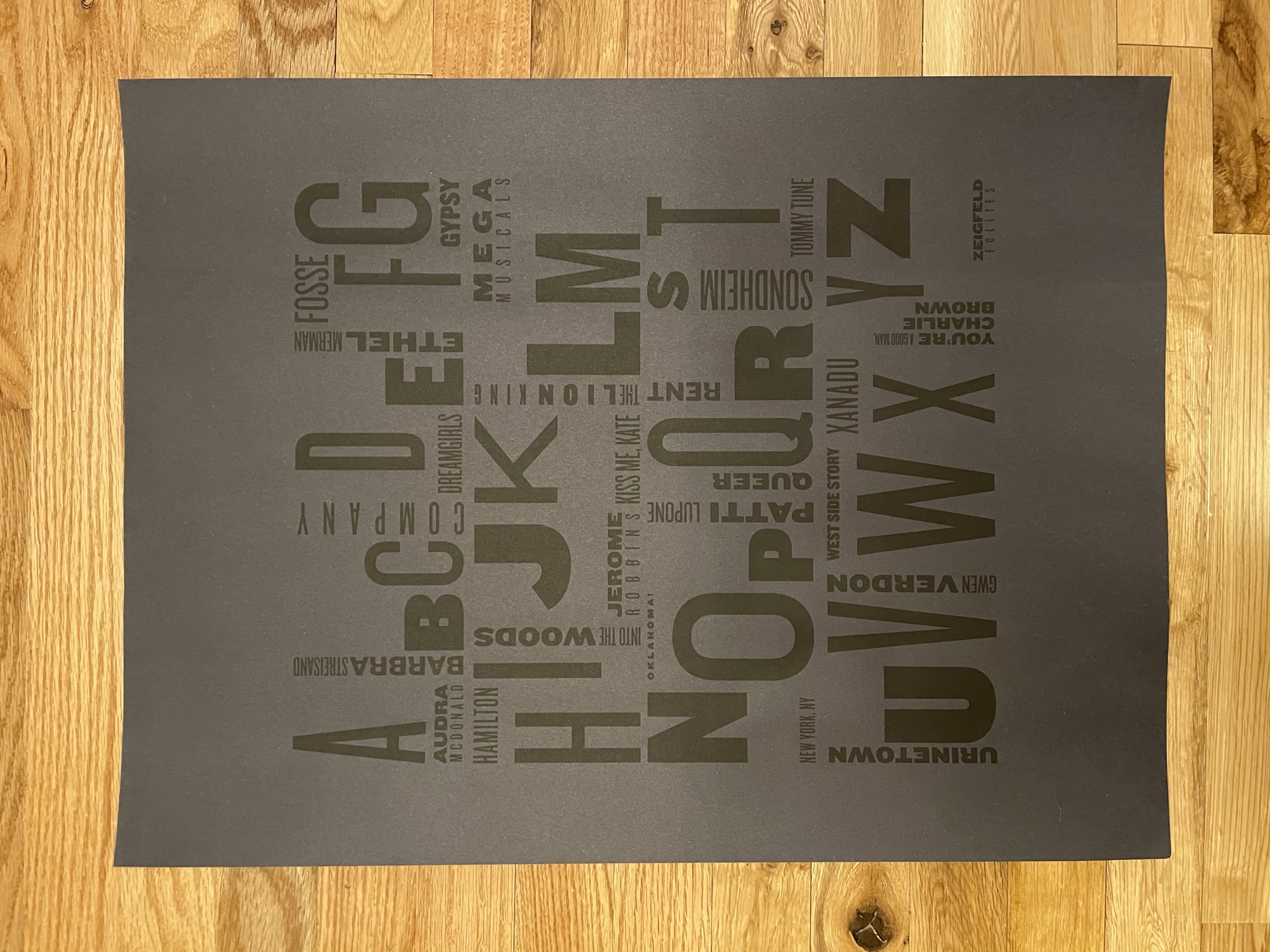
Twenty-six choices, in order, by hand. The whole alphabet is one long sentence about Broadway. The piece works as a sequence; pulling any one letter out misses the point.
See Broadway A to Z →If you're not consciously shaping those beats, someone else is, probably in a spec doc, probably with no real sense of pacing, tone, or emotion.
Don't let someone else define your sequence.
Try this: In your next kickoff, draw the user's journey first. Skip the flowchart and draw the emotional arc. Where's the tension? Where's the relief? Where's the moment that makes the whole thing worth it? Get the team aligned on those answers before anyone opens Figma.
If You Can't Explain It, It Doesn't Matter How It Looks
A beautiful UI that can't be explained in plain terms is just ornament. You should be able to walk someone through your work in plain, human language, not buzzwords, not design jargon, but something like this:
- "Here's what we learned."
- "Here's the moment we're designing for."
- "Here's why this matters."
- "Here's what we're asking the user to understand or believe."
If you can't explain your work with clarity, it's not ready. If you wait for a PM to write that story for you, they will, through their lens, in their language.
And then you'll be back where we started: wondering why no one gets what you built.
Storytelling Is Infrastructure
Narrative is how we align teams. It's how we know what we're building and whether it's working. It's how engineering prioritizes. It's how marketing positions. It's how leadership advocates.
And it's how users understand what the hell we've made for them.
So why are designers still being trained like storytelling is a "plus" instead of a core skill?
Storytelling is essential.
We Translate Truth
The best design storytelling is reported. We don't invent narratives. We distill them from research, from real experiences, from conversations, workarounds, pain points, and aspirations.
The most compelling design stories are honest.
And they're tailored. We don't tell the same story to everyone. We shape it based on what each audience needs to hear to act with confidence.
- To engineers: we clarify sequence and logic.
- To PMs: we clarify tradeoffs and purpose.
- To users: we clarify value and timing.
This is translation.
Storytelling Is Design Leadership
You want to lead? Start telling the story.
Don't wait until it's done. Don't wait for the deck. Don't ask someone else to translate it for you.
Start narrating the work from day one. Give people a reason to care. Give them a reason to trust the direction. And give yourself the authority that comes from being the one who actually knows what's going on.
Designers who own the narrative get more clarity, more alignment, and more impact, because they know what they're saying and why it matters.
Try this tomorrow
In a meeting (kickoff, sync, critique) don't show the artifact first. Tell the story: the human story, the problem, the insight, the turning point, the stakes.
See what happens when the team understands the experience before they see the interface.
See what happens when you narrate the work the whole way through.
You are the director. Own the narrative.